Ten things to fix before day three
Batch your broth and noodles before opening, keep one spare tare and drink stock, close the register whenever you walk the floor, and secure cutting boards so prep never slides. Most 'unfair' early moments trace back to one of these habits.
Small habits separate a shop that grows from a shop that survives. Every item below comes from the launch build — either from a system the game taught us or from a mistake players keep reporting in their first week.
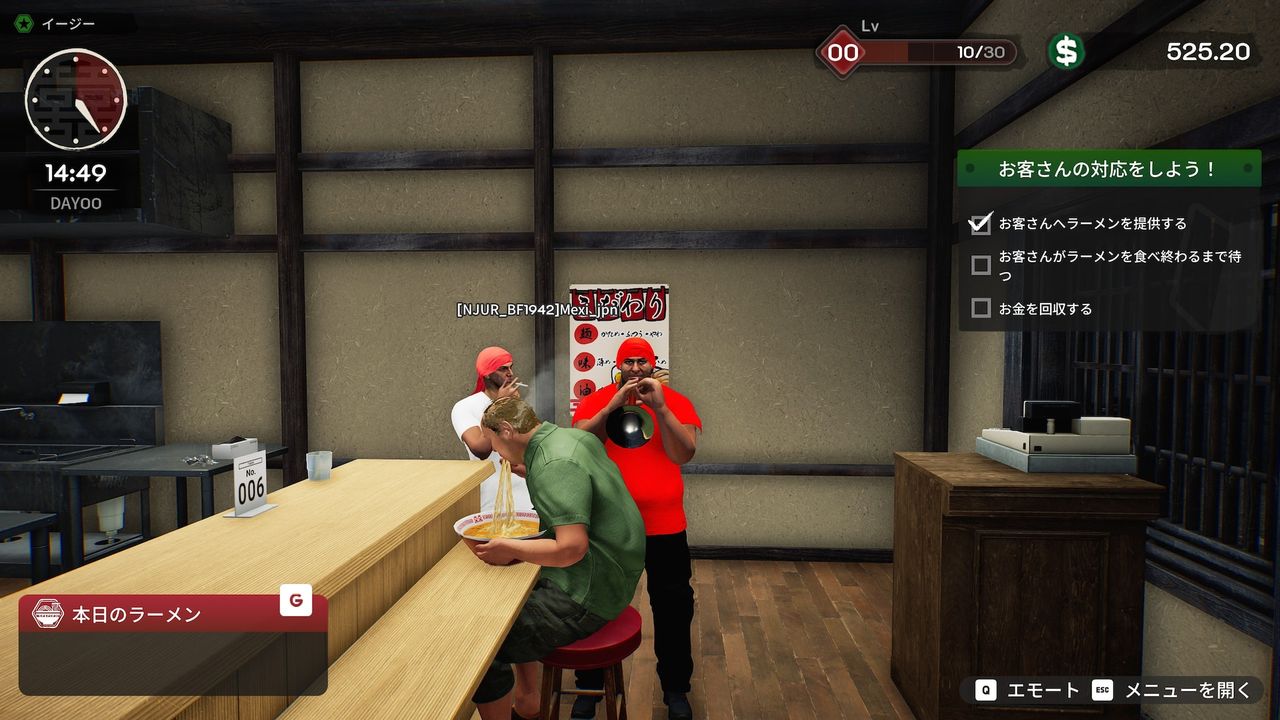
Screenshot: a full house mid-service. — by guri22 via Steam Community
1. Start broth before you touch anything else
Broth is a slow-cook item in a world of fast tasks. The shops that stall always stall the same way: service starts, orders stack up, and the pot runs dry. Start the broth, then do everything else while it works — and top up a second pot before the dinner push, not during it.
2. Close the register every single time
An open register is a standing invitation. Thieves in this game do not check whether you are busy, closed, or squinting at the management computer — and solo players report exactly those three scenarios. Make closing the drawer part of every walk-away: serve, pay, close, move.
3. Order supplies like tomorrow exists — not like next week does
Perishables and refills are the quiet leak in most shops: over-ordering buries cash in stock that expires, under-ordering ends a service early. Since the Day-1 patch, leftovers in the fridge and on the sample shelf survive overnight — so stocking one good day ahead is finally safe.
4. Mind the egg carton cap
The Day-1 build caps egg cartons at six per purchase. If ajitama is in your standard bowl, that cap is your real per-run ceiling. Buy eggs early and repeatedly rather than in one heroic order.
5. Match firmness exactly
Noodle firmness is part of the score, not a preference. The most common "angry customer" in our comment threads is not a slow bowl — it is a soft noodle sent on a firm ticket. Read the ticket at the basket, not at the bowl.
6. Carry the tare correctly
You can hold five tare bottles now, but pouring demands exactly one. Grab, pour, return — and watch the stack display: bottled items now show the top item's remaining amount, which is your cue for when a line is nearly dry.
7. Secure your cutting boards
Placed cutting boards can be locked in place with a right-click (new in the Day-1 build). Prep slides are the most annoying small failure in a crowded kitchen; securing boards is free and instant.
8. Serve beer to the line, not to the rim
Beer is the trap item: filling under 70% of the mug costs rating points, and serving with no foam draws a warning. Pour against the side of the mug, let foam build to a reasonable head, and you will never see either message again.
9. Do not fight the handcart
The supply handcart handles like an actual handcart. Short inputs, wide turns, and it will not embarrass you — the Day-1 patch retuned its acceleration and turning. Players who "drive" it like a car keep bouncing off doorframes; players who poke it get the job done.
10. Spend on throughput, then on beauty
Upgrade stations, storage and washing capacity first; buy decor when the kitchen can fund it. A pretty dining room cannot survive a kitchen that delivers bowls cold, and the deepest trap in the shop-building system is decorating at level 8 what you will demolish at level 10 when expansion unlocks.
Three "mistakes" that are actually features
- A customer leaving unhappy is data. Check the ticket before you blame the engine — firmness, toppings, temperature. The game tells you what it wanted.
- Critic refusals are scheduling. Critics can only be invited before opening; if you missed the window, that is a rule, not a bug.
- Early levels fly by on purpose. Levels 1–5 take a session; the ladder deliberately front-loads onboarding before the money math begins.